Two Arts, One Homeland
Sichuan has given the world many things — fiery cuisine, giant pandas, and the poetry of Li Bai. But its most enduring export is silk, and within that tradition, two crafts stand above all others: Shu embroidery (蜀绣, shǔxiù) and Shu brocade (蜀锦, shǔjǐn).
They are often confused. They are not the same thing. One is needlework — threads sewn onto fabric to create images. The other is weaving — threads interlaced on a loom to create patterned cloth. But both share the same DNA: Sichuan silk, Sichuan artisans, and a history that stretches back to before the Qin dynasty unified China in 221 BC.
Together, they form the twin pillars of Sichuan's silk heritage — and both are recognized by UNESCO as Intangible Cultural Heritage.
Shu Embroidery: Painting with Silk Thread
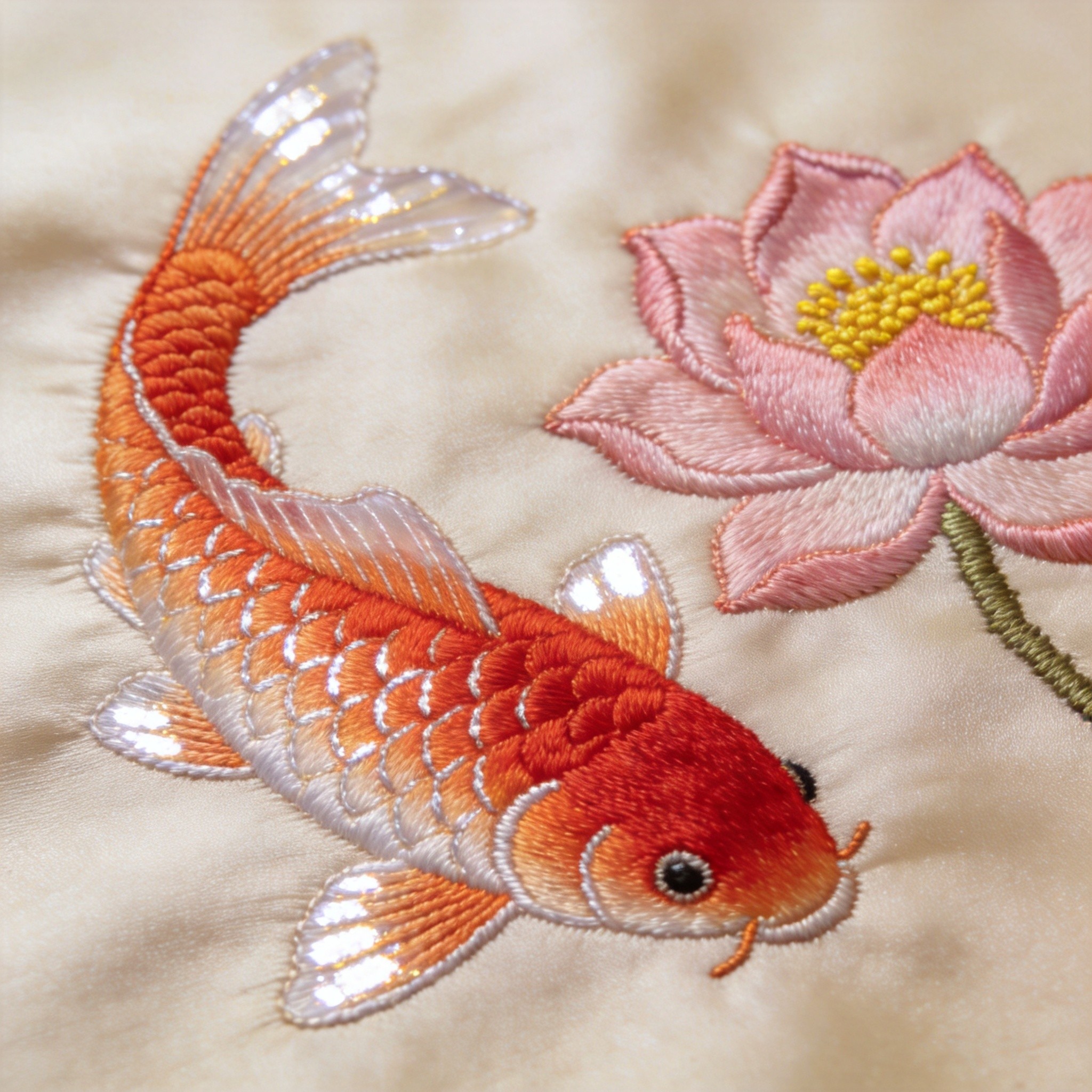
Shu embroidery is one of China's Four Great Embroideries — alongside Su (Suzhou), Xiang (Hunan), and Yue (Guangdong). But Shu is the oldest of the four, with archaeological evidence dating back to the Warring States period (475–221 BC).
What makes Shu embroidery distinct is its satin stitch (晕针) technique — a method so refined that the threads lie flat and parallel, creating a surface so smooth it resembles oil painting rather than needlework. The colors blend seamlessly into one another, producing gradients that other embroidery traditions cannot match.
The traditional subjects tell you everything about the land that created them:
- Pandas and bamboo — Sichuan's most iconic residents
- Carp and lotus — symbols of perseverance and purity
- Peonies and phoenixes — imperial grandeur and renewal
- Landscapes of the Shu mountains — misty, layered, atmospheric
A single piece of Shu embroidery can take months or even years to complete. The finest works use over 100 different thread colors, with stitches so fine that a single square centimeter may contain over 100 needle points. This is not craft. This is patience made visible.
Shu Brocade: The World's First Programmed Art
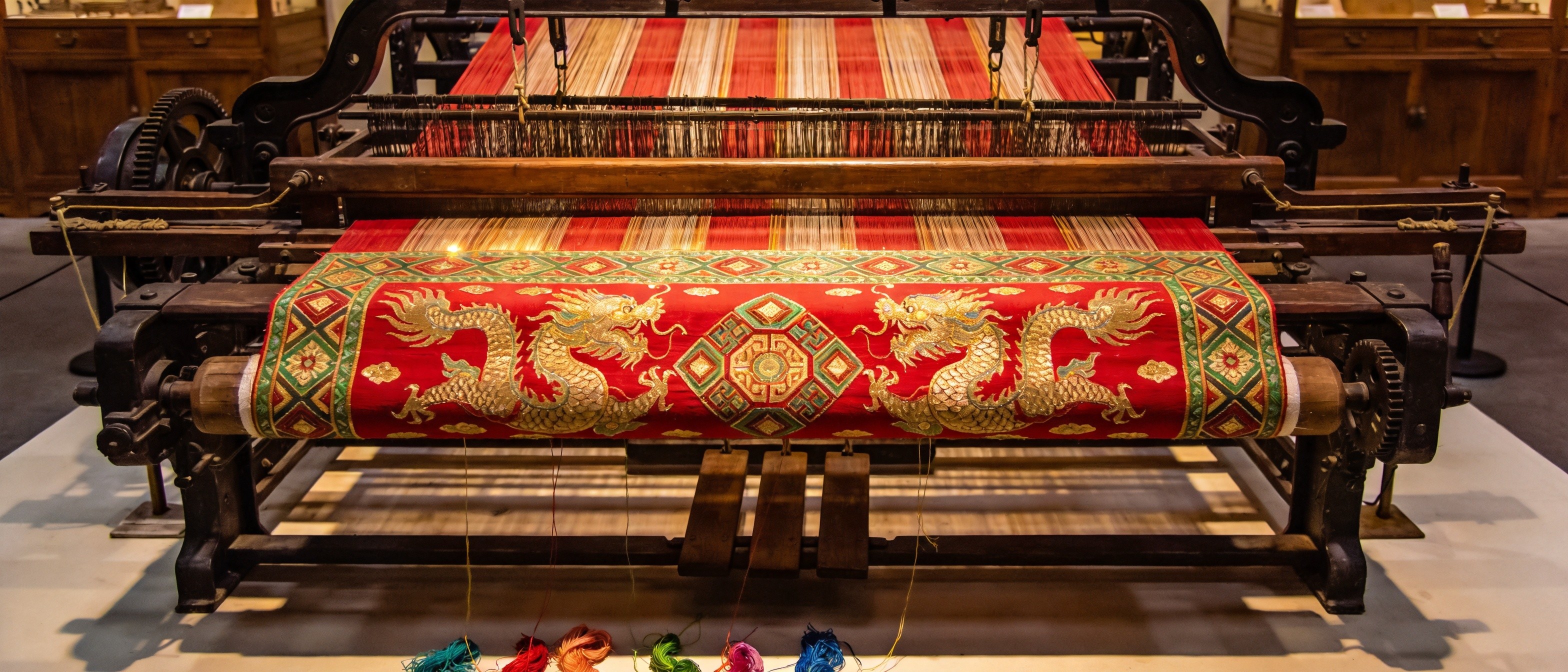
If Shu embroidery is painting, Shu brocade is architecture — built thread by thread, row by row, on a loom that is itself a masterpiece of engineering.
Shu brocade is the oldest of China's Four Great Brocades — older than Song brocade (Suzhou), Yun brocade (Nanjing), and Zhuang brocade (Guangxi). Its origins trace to the Han Dynasty (206 BC – 220 AD), when Chengdu — then called Shu — was already producing patterned silk that astonished the imperial court.
Here is what makes Shu brocade technically extraordinary: the multi-warp patterning technique (多经提花). Before a single thread is woven, the entire pattern is "programmed" into the warp threads — a system of lifting and dropping threads that predates the Jacquard loom by nearly 1,800 years. In essence, Shu brocade weavers invented binary logic for pattern-making, centuries before a computer existed.
The classic Shu brocade patterns are unmistakable:
- Rainbow brocade (雨丝锦) — fine vertical lines like rain on a window
- Square brocade (方方锦) — geometric grid patterns in contrasting colors
- Tiao-brocade (条锦) — horizontal bands of repeating motifs
- Pearl brocade (珠锦) — dotted patterns resembling scattered pearls
- Plum blossom brocade (梅锦) — stylized blossoms on a colored ground
Each pattern has been passed down through generations of weaving families — not written in books, but stored in muscle memory and in the physical configuration of the loom itself.
The Tang Dynasty: When Shu Silk Ruled the World
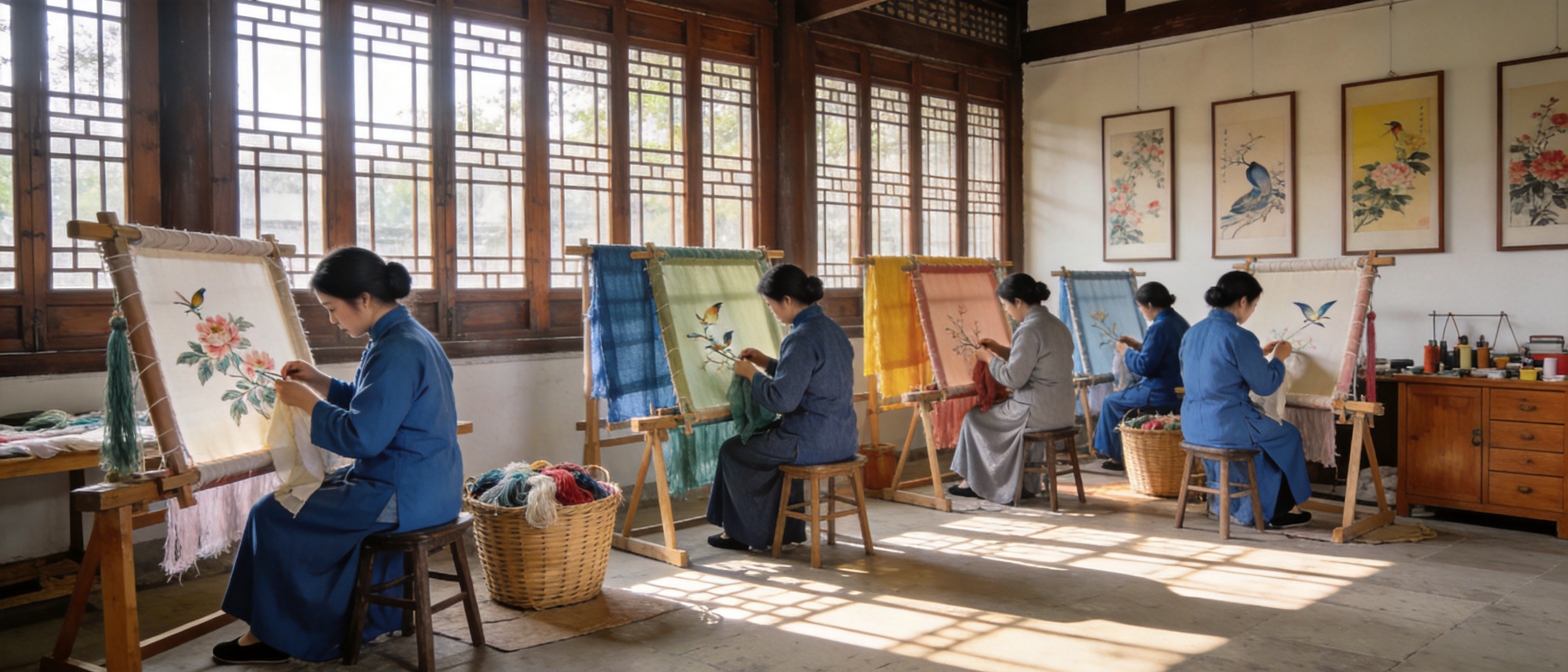
The Tang Dynasty (618–907 AD) was the golden age of both Shu embroidery and Shu brocade — and the reason was geopolitical.
When the An Lushan Rebellion devastated northern China in 755 AD, Emperor Xuanzong fled to Sichuan. The imperial court followed. And with it came the empire's greatest demand for luxury silk — robes for officials, gifts for foreign envoys, ceremonial garments for the court.
Chengdu answered. The city's silk workshops expanded rapidly, and both embroidery and brocade reached new heights of technical sophistication. Shu brocade became the standard fabric for imperial edicts — the emperor's words literally written on Sichuan silk. Shu embroidery adorned the walls of palaces and the garments of concubines.
The Tang poet Du Fu, who lived in Chengdu for years, wrote of the city's silk markets:
"Brocade officials manage the spring wind, ten thousand threads shimmer in the sun."
Chengdu's official title during this period was "Brocade City" (锦城, Jǐnchéng) — a name that survives to this day. The river that flows through the city was called the "Brocade River" (锦江, Jǐnjiāng), because the weavers washed their finished silk in its waters, and legend said the colors made the river glow.
Survival Through the Centuries
Every dynasty brought new challenges. The Mongol invasion of the Song Dynasty destroyed workshops across Sichuan. The Ming-Qing transition scattered weaving families. The modernization of the 20th century nearly killed both traditions entirely.
But Shu silk has always rebuilt itself — because the knowledge lives in people, not in buildings.
In 2006, Shu embroidery was inscribed on China's National Intangible Cultural Heritage list. In 2009, Shu brocade received the same recognition. Both were later recognized by UNESCO as part of the world's living heritage.
Today, a new generation of artisans is learning the old ways — not just to preserve them, but to push them forward. Contemporary Shu embroidery artists create works that combine traditional technique with modern aesthetics. Shu brocade designers are experimenting with new colorways and pattern combinations while maintaining the ancient weaving methods.
What It Means for Sourcing
For buyers of Sichuan silk, the heritage of Shu embroidery and Shu brocade is more than cultural context — it is a quality guarantee.
The same region that produced imperial-grade silk for 3,000 years still produces silk today. The mulberry groves still grow. The silkworms still spin. The artisans still work — not in factories, but in workshops where skill is measured in decades, not output.
When you source silk from Sichuan, you are not just buying fabric. You are buying into a supply chain with a 3,000-year track record — the longest unbroken silk tradition on earth.